What Makes a Clover Leaflet Different from a Leaf?
Learn how a clover leaf differs from its leaflets, so you can describe a four-leaf find accurately and record where it joins the stem.
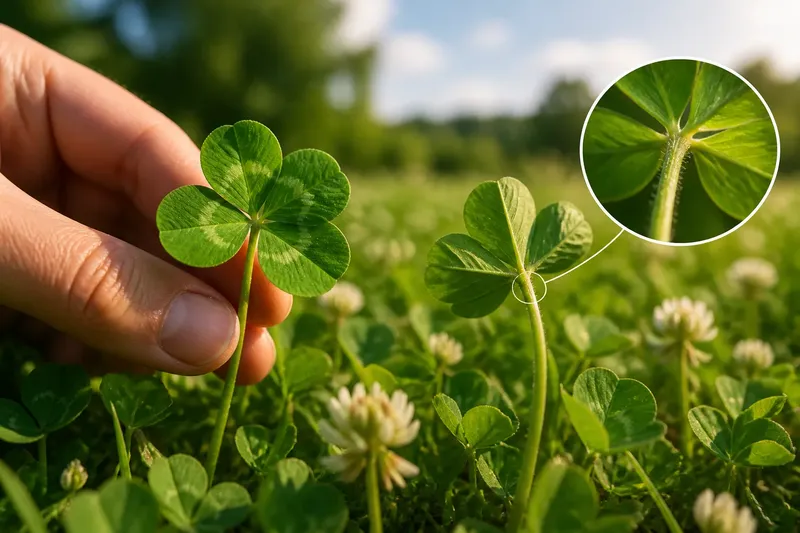
You spot a four-part clover in the lawn and reach for your phone, but the description gives you pause: are those four leaves, or four leaflets on one leaf? In ordinary conversation, “four-leaf clover” is clear enough. In botany, the distinction matters: the whole leaf is one structure, and its leaflets are the smaller parts arranged at the tip.
A week of casual observation is enough to get comfortable with the difference. The useful habit is to look beyond the green shapes and trace how they connect to the stem. Once you can find that attachment point, you can describe a four-leaf find without confusing the number of leaflets with the number of leaves.
Start at the stem
A clover leaf grows from a stem at a distinct point called a node. From that point, a slender leaf stalk, or petiole, extends outwards. At its far end, the stalk supports the familiar cluster of leaflets. In a typical three-part clover leaf, all three leaflets belong to that one stalk and share the same point of attachment.
To inspect a plant, follow one leaf stalk back from the cluster. Do this gently, without pulling the leaf or bending the stem. If several apparent leaves overlap, choose a single cluster and trace its stalk until it meets the stem. The junction is more informative than a quick count of green shapes.
By contrast, separate leaves have separate attachment points on the stem, even if their stalks cross or emerge close together. A single clover stem can carry many leaves at different nodes, each with its own stalk and leaflet cluster. That arrangement can make a dense patch look confusing, especially when the plant is low to the ground.
Read the whole leaf
Think of the clover leaf as a complete unit: stalk plus the leaflets it carries. The leaflets are the divided portions of its blade. They may look like independent leaves because each has its own outline and surface, but they do not each attach separately to the main stem.
One visual clue is the small junction where the leaflet stalks meet at the end of the petiole. The junction may be subtle, and the parts can overlap, so do not rely only on the shape of the cluster. Follow the connections. A close view from the side can reveal the stalk beneath the leaflets more clearly than a straight-down photograph.
The distinction is useful in a field note. “One clover leaf with four leaflets” identifies the structure precisely, while “four leaves” could mean four separate leaves on a stem. For a casual caption, “four-leaf clover” remains familiar shorthand; for comparing plants or describing an observation, “four-leaflet leaf” removes ambiguity.
Follow a week of looking
Use a small routine rather than trying to memorise every botanical term at once. Choose a patch you can revisit, such as a lawn edge or a clover-filled path verge. Avoid trampling the plants, and leave any interesting leaf attached while you examine its connections.
- Day one: Find a typical three-leaflet clover leaf. Trace its petiole to the stem, then note where that stem continues.
- Day two: Look for a second leaf on the same stem. Trace its own petiole separately, even if it sits beside or beneath the first.
- Day three: View a cluster from the side. Notice whether you can see a common junction for its leaflets.
- Day four: Photograph a leaf from above and then at a shallow angle. Compare which view makes the stalk and junction easier to follow.
- Day five: Inspect an unusual cluster without disturbing it. Count the leaflet blades, then trace the supporting petiole back to the stem.
- Day six: Write a short note using both terms: the number of leaflets and the number of leaves you can trace to separate stem points.
- Day seven: Return to your first plant and check whether your description still fits what you can see. Adjust the wording if a crossing stalk made the original view misleading.
Keep the routine observational. A notebook, phone camera and a clear view are enough; there is no need to pluck the plant. If you photograph it, include the stem junction as well as the leaflet cluster. A picture showing only the top of the leaf may preserve its appearance but leave the attachment unclear.
Describe four leaflets accurately
When a clover leaf has four leaflets, the count refers to the parts at the end of one petiole. It does not mean that four separate leaves meet at a single point on the main stem. This is why the attachment is central to identifying the structure: a cluster of four green shapes is suggestive, but tracing their support establishes what the count describes.
Say you notice an unusual cluster beside a garden path. You photograph it from above, then take a second image from the side and follow its stalk to the stem. If both views show four leaflet blades connected to one petiole, you can record “one leaf with four leaflets” rather than simply “four leaves”; the added view also makes your observation easier to interpret later.
In a patch with overlapping growth, make the description cautious if you cannot trace every connection. Write that the cluster appears to have four leaflets, or take another view after moving your position. Do not pull neighbouring stems apart just to make a photograph clearer. A careful description of what is visible is more useful than a confident count based on a tangle.
Common points of confusion
Small clover leaves can sit so close together that their stalks seem to share one point. Look for separate petioles emerging at different places along the stem. Their angles may overlap in a photograph, but the underlying connections remain distinct when viewed from another side.
A leaflet can also fold, overlap another leaflet or be partly hidden. Count visible blades only when you can distinguish their edges and connections. If the view is incomplete, note that rather than treating a shadow or a folded portion as another leaflet.
Finally, familiar names do not always follow botanical wording. People commonly call the whole cluster a “clover leaf” and may call an unusual specimen a “four-leaf clover”. There is no need to correct casual speech. Use the more exact terms when the difference helps someone understand what you observed.
Questions about clover leaves?
Is a clover leaflet a separate leaf?
No. A leaflet is one part of a divided leaf blade, while the complete clover leaf includes the stalk and its leaflet cluster. Its leaflets share a connection at the end of that stalk.
How can I tell one leaf from two overlapping leaves?
Trace each petiole back to the main stem. Two separate leaves have separate attachment points, even when their leaflets overlap or their stalks cross.
What should I call a four-part clover leaf?
For precise description, call it one leaf with four leaflets. “Four-leaf clover” is widely understood in everyday use, but it can sound as though four separate leaves are involved.
Can a photograph show the difference?
Yes, if it includes the petiole and enough of the stem to show where the leaf attaches. A side view can clarify connections that are hidden in a photograph taken directly from above.
Keep the distinction handy
The simplest rule is to count the leaflet blades at the end of a petiole, then count separate petioles where they meet the stem. That gives you two different observations: how many parts belong to a leaf, and how many leaves grow from the stem.
Next time a four-part clover catches your eye, take a moment to follow its stalk before naming it. “One leaf with four leaflets” says exactly what you saw, and the same habit makes ordinary three-part leaves easier to read in a crowded patch.